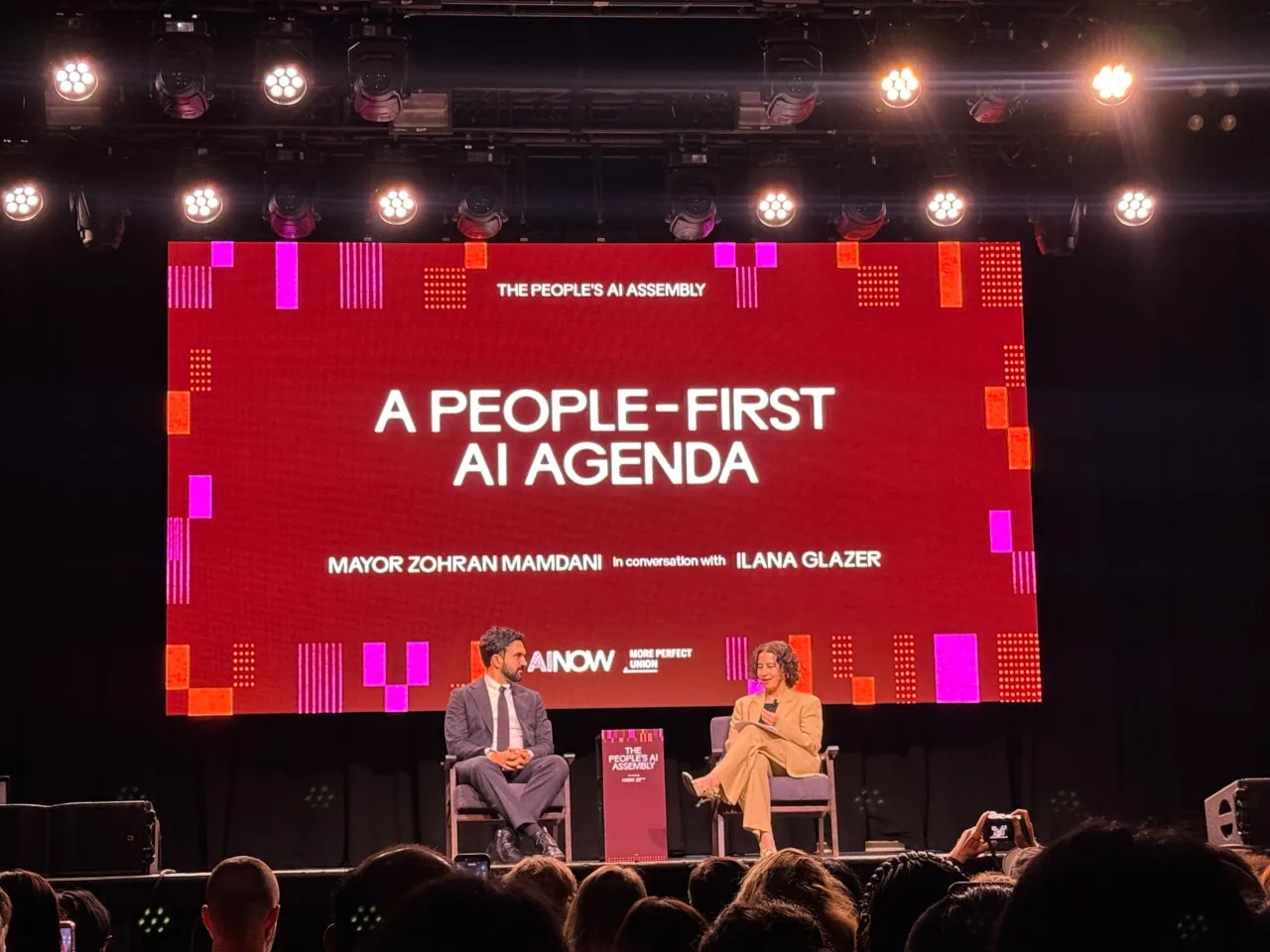
On Monday evening, two prominent New York figures—Zohran Mamdani and activist/actress Ilana Glazer (star of Broad City)—spoke about artificial intelligence at Webster Hall in Manhattan. During the event, Glazer posed questions to Mamdani regarding the future of AI in society.
Mamdani encouraged New Yorkers to push back against the prevailing sense that AI will inevitably strip them of their jobs, their children’s minds, and their own dignity—urging them instead to reclaim control.
His remarks come at a time when the federal government’s lack of robust AI regulation has left individual cities to fend for themselves. Speaking at the “People’s AI Summit”—hosted by the AI Now Institute, a research organization focused on the field—Mamdani argued that the rapid proliferation of AI technology is not inevitable, and that government officials should hold AI companies accountable.
Last month, Mamdani called for a ban on the use of artificial intelligence in elementary and middle schools. Glazer, who is a parent, expressed her unease regarding the introduction of this technology into classrooms.
“It makes me uncomfortable. It feels like there was absolutely no consent—as if this has to happen in schools. It wasn’t like this two years ago. Why does it have to happen in schools now?” she said.
This summer, Mamdani also introduced a policy requiring landlords, brokers, and real estate platforms to explicitly disclose whether photos or videos in property listings have been generated using artificial intelligence. The policy is intended to protect New Yorkers from “bait-and-switch” tactics—specifically, being deceived by misleading real estate listings.
Both initiatives challenge the assumption that schools and the general public have no choice but to accept the arrival of artificial intelligence.
“It doesn’t have to be this way,” Mamdani said at an event on Monday. “This approach is chilling—it carries an oppressive intent, creating the impression that there is no other choice.”
He pointed to a trend of “reckless adoption of technology, regardless of its limitations,” citing a U.S. military strike on a school in Iran in February that left more than 150 people dead, including at least 123 children. Officials involved in an internal Pentagon investigation told Bloomberg that an over-reliance on artificial intelligence for target identification was a contributing factor to the strike.
“There’s a tendency to portray AI as flawless, beyond question—as something that can only be regulated by those who are developing it,” Mamdani said, noting that Facebook had advanced a similar argument as far back as 2008. “In reality, however,” he continued, “this is an attempt to evade accountability at every level, all while ensuring that the potential valuation for an IPO remains unaffected.”
Anthropic is expected to go public this year, while OpenAI has indicated plans for an IPO in 2027.
Mamdani criticized the “complete absence of federal law” regarding artificial intelligence.
“At the national level, the conversation around AI is often framed as an arms race with China,” the mayor said. “Any concerns related to humanity are sidelined, subsumed by the rhetoric of national competition.”
Earlier this month, President Donald Trump announced the creation of a task force on superintelligence—an initiative focused on allowing powerful AI companies to self-regulate, rather than establishing new federal restrictions. This approach persists despite growing concerns about the impact of AI on every facet of human life—including warnings from whistleblowers at companies like Anthropic, Google DeepMind, and OpenAI that AI could potentially lead to human extinction.
“As we look beyond the current federal administration, we must develop an entirely different framework for how we think about AI, how we discuss it, and the level of accountability we are prepared to demand,” Mamdani said.